

HELLO, WELCOME TO HOWES
There are many variations of passages of Lorem Ipsum available, but the majority have suffered alteration in some form, by injected humour, or randomised words which don't look even slightly believable. If you are going to use a passage of Lorem Ipsum, you need to be sure there isn't anything embarrassing of text.
EASY TO CUSTOMIZE
Lorem Ipsum is simply dummy text of the printing and typesetting industry. Lorem Ipsum has been the dummy text ever since.
FONT AWESOME ICON
Lorem Ipsum is simply dummy text of the printing and typesetting industry. Lorem Ipsum has been the dummy text ever since.
SEO FRIENDLY
Lorem Ipsum is simply dummy text of the printing and typesetting industry. Lorem Ipsum has been the dummy text ever since.
LATEST NEWS

Understanding Tacho Generators
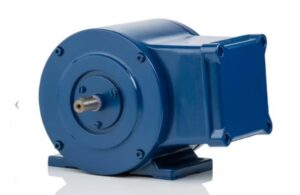
What is a Tacho Generator?
There are many ways to measure the position of a rotary axis. Some position-measuring devices, such as absolute and incremental encoders, can also determine the speed of the axis by evaluating a combination of distance, pulses, and time. However, a tacho generator may be the most suitable option for applications requiring speed measurement only- without position information. If you have read our blog on Generator Excitation Control Systems, you will recall that a generator converts mechanical energy into electrical energy. The voltage of the generated power is directly proportional to the device’s shaft speed. Tacho generators were specifically designed to ensure that the relationship between voltage and speed remains precise and linear within a specific range. [1] Tacho generators are true speed-measuring devices that rely on the basic principle of a generator to determine the speed of a rotating part based on voltage. To measure the speed of a device — such as a fan or motor shaft —the tacho generator must be attached to the device itself to evaluate the voltage of the power produced by the generator to determine the device’s rotational speed. The formulas can be found below: [2]
Types of Tacho Generators
There are two basic types of tachometric generators, namely:- A commutator generator
- A synchronous generator.
Commutator Generator
A commutator transforms the alternating current produced by rotation right into direct current that can be analysed by a voltmeter circuit and transformed to speed. If the direction of rotation changes, the voltage polarity modifies, so the DC tacho generator can determine both the speed and direction of rotation.Three-Phase Synchronous Generator
An AC tacho generator does away with brushes and uses a stationary, wound stator and a rotor with permanent magnets. In this case, the rotating magnetic field of the rotor induces voltages in the 3-phase windings of the stator. The amplitude and frequency of the induced voltage are proportional to the rotation speed. The AC output is rectified to a DC voltage whose amplitude is proportional to the rotation speed, and the rectified output goes through a smoothing filter to reduce voltage ripples. Because AC current changes polarity twice per electrical cycle, an AC tacho generator cannot determine the direction of shaft rotation like a commutator generator. However, they have a greater lifespan because they don’t require mechanical brushes. Tacho generators are typically used with DC motors and drives in motion control applications to control motor speed.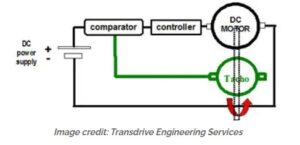 In case you were wondering, your car's tachometer is a tacho generator with an analog dial or digital display.
TDP/S – Tacho Generators Offered By Huebner Speed Monitoring
Huebner Speed Monitoring Tacho generators are analogue transducers for instrumentation and control technology. These permanently excited generators form the speed with which they are driven to a voltage proportional to that speed. Thanks to their robust design and construction, they are suitable for larger industrial drives. Depending on the requirements, the HUBNER GIESSEN Tacho generators are produced in customized sizes and connections and in various voltage versions. They are available with IP ratings IP55 to IP68 and have a temperature compensation of up to +100'c.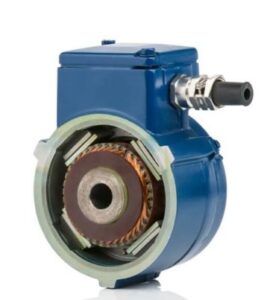 Contact Huebner Speed Monitoring for all your questions, orders, and enquiries.
References and Research:
[1] [2] https://www.motioncontroltips.com/
Generator Excitation Control Systems
- Shunt or Self Excited
- Excitation Boost System
- Permanent Magnet Generator (Three phase synchronous generator)
- Auxiliary Winding
What is Excitation?
There are two main sources of energy conversion: a motor and a generator. Generators convert mechanical energy into electrical energy by moving the electrical conductors in a magnetic field. In order for this conversion to take place, excitation creates the electromagnetic field by means of an electric current to enable the energy conversion. An electric generator or motor consists of a rotor spinning in a magnetic field. The excitation process provides direct current (DC) to the rotor windings to control the magnetic field’s strength. Excitation current (DC) is supplied using either brushed or brushless excitation means. However, most modern generators today use brushless excitation since it requires less maintenance.Three-Phase Synchronous Generator
Three-phase synchronous generators are used in nearly all commercial power plants. The least common type is the induction generator. Three-phase synchronous generators are also known as alternators because they convert the mechanical energy from the prime mover (gas turbine, steam turbine, water turbine, etc.) into electrical energy, as explained above. They are highly efficient thanks to their permanent excitation. The synchronous generator is a type of AC generator. Popular applications include energy generation in wind turbines, steam turbines, and hydro turbines. A static or rotating magnetic field constructs the synchronous generators used in our industries.Working Principle of Synchronous Generator
- The working principle of a synchronous generator is based on Faraday’s Law of electromagnetic induction.
emf= dΦ/dt
- This law says that the rate of change of flux in any device will produce EMF in that device. If a device is static and the field is rotating, it will also produce a field in the device.
- In the case of a synchronous generator, the rotor is rotating, producing a field in the stator.
 Image Source: theengineeringknowledge.com
Synchronous Generator Construction
- There is no residual magnetism in a synchronous generator to produce self-excitation.
- The external DC supply is provided to the rotor, which produces a magnetic field in the rotor. When the rotor is rotated by means of mechanical energy, its field links with the stator windings to produce a voltage in the stator.
- There are two terms commonly used to describe windings in a machine, namely: armature windings and field windings.
- The windings that produce the main field in a machine are called field windings, and the windings that produce voltage are called armatures.
- In the application of a synchronous generator, the field windings are the rotor windings, and the stator windings are the armature windings.
Stator Core and Windings
[1] Manufactured from laminate steel, the stator has milled slots along its entire length that are filled with copper conductor windings. Each winding slot is fitted with a wedge to prevent the copper windings from being displaced due to the centrifugal forces created during operation. An alternating current is induced in the stator windings as the rotor's magnetic fields intersect with the windings.Rotor and Windings
[2] The rotor consists of solid steel with slots milled along its entire length; the slots are filled with copper conductor windings. Direct current (DC) is supplied to the rotor windings to produce an electromagnetic field around the rotor. As the rotor rotates, the north and south of its magnetic fields will induce alternating current (AC) flow in the stator windings.Bearings
[3] Bearings support the weight of the shaft when the generator is idle and in operation. Small units may use anti-friction roller bearings, but larger units use plain/sliding bearings. Where plain bearings are used, the lubricating oil pressure must be maintained when the generator is in operation. A reduction in lubrication oil pressure will damage the bearings and shaft.Cooling System
[4] Cooling is achieved by air, hydrogen, or water. Smaller generators can be air-cooled, but larger units are often hydrogen cooled, while the very large units can be water-cooled.Frame
[5] The frame houses the stator, rotor, bearings, and cooling channels used by the generator. It provides the structural strength needed to mount all of the components and is designed to absorb vibration.Bushings
[6] Bushings are used to pass electrical current through the enclosure of the generator without raising the electrical potential of the generator casing. Bushings usually consist of an aluminium or copper central conductor and a porcelain insulator.Retaining Ring
[7] Retaining rings place residual compression stress upon the rotor windings; this counteracts the centrifugal forces the windings are subjected to when the generator is in operation.Cooling Fans
[8] Air is drawn through the generator casing using single-stage axial fans; it removes waste heat from the generator casing.Choosing Huebner Speed Monitoring for Your Three-Phase Synchronous Generator
Well-designed excitation systems provide reliability of operation, stability, and fast transient response. Huebner Speed Monitoring offers just that; a DSG P synchronous generator that is robust, permanently excited, and highly efficient.
 Contact Huebner Speed Monitoring for all your questions, orders, and enquiries. Alternatively, click here to learn more.
Resources:
[1] [2] [3] [4] [5] [6] [7] [8] https://www.theengineeringknowledge.com/introduction-to-synchronous-generator/ https://savree.com/en/encyclopedia/three-phase-synchronous-generatorOUR SERVICES
Lorem ipsum dolor sit amet, consectetur adipisicing elit, sed do eiusmod tempor incididunt ut labore consectetur adipisicing elit, sed do eiusmod tempor incididunt ut. interdum dapibus. Curabitur euismod sem vel velit blan Aenean molestie faucibus fringilla.
Lorem ipsum dolor sit amet, consectetur adipisicing elit, sed do eiusmod tempor incididunt ut labore consectetur adipisicing elit, sed do eiusmod tempor incididunt ut.
Lorem ipsum dolor sit amet, consectetur adipisicing elit, sed do eiusmod tempor incididunt ut labore consectetur adipisicing elit, sed do eiusmod tempor incididunt ut.
Lorem ipsum dolor sit amet, consectetur adipisicing elit, sed do eiusmod tempor incididunt ut labore consectetur adipisicing elit, sed do eiusmod tempor incididunt ut.
Lorem ipsum dolor sit amet, consectetur adipisicing elit, sed do eiusmod tempor incididunt ut labore consectetur adipisicing elit, sed do eiusmod tempor incididunt ut.
Lorem ipsum dolor sit amet, consectetur adipisicing elit, sed do eiusmod tempor incididunt ut labore consectetur adipisicing elit, sed do eiusmod tempor incididunt ut.
OUR CLIENTS
Eum case latine scripta ex, elitr affert diceret has ad, malis hendrerit ad pro.
Aenean egestas semper arcu, in rhoncus ligula tincidunt non. Sed laoreet diam vel justo tempus pulvinar curabitur scelerisque tincidunt lorem quis velito tempus pulvinar curabitur scelerisque tincidunt lorem quis velit.
Aenean egestas semper arcu, in rhoncus ligula tincidunt non. Sed laoreet diam vel justo tempus pulvinar curabitur scelerisque tincidunt lorem quis velito tempus pulvinar curabitur scelerisque tincidunt lorem quis velit.
Aenean egestas semper arcu, in rhoncus ligula tincidunt non. Sed laoreet diam vel justo tempus pulvinar curabitur scelerisque tincidunt lorem quis velito tempus pulvinar curabitur scelerisque tincidunt lorem quis velit.
Aenean egestas semper arcu, in rhoncus ligula tincidunt non. Sed laoreet diam vel justo tempus pulvinar curabitur scelerisque tincidunt lorem quis velito tempus pulvinar curabitur scelerisque tincidunt lorem quis velit.
TEAM MEMBERS
Usu natum maiestatis at ius iriure mediocrem indicant ceter.